
FastAPI Cloud in Public Beta
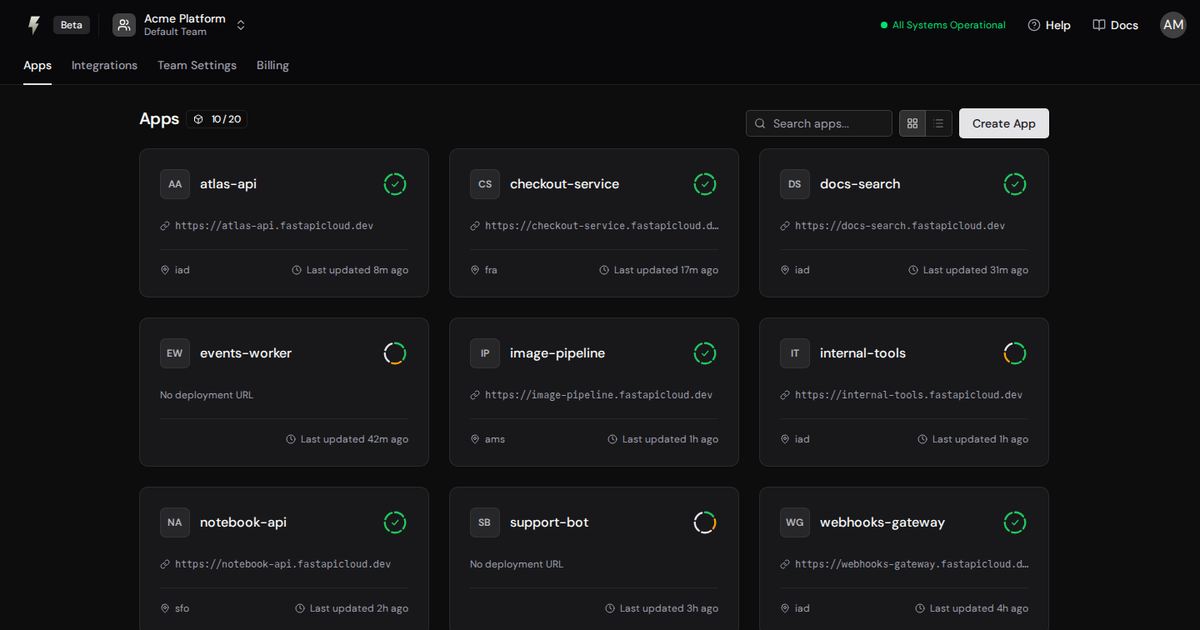
FastAPI Cloud is in public beta! 🎉
If you’ve been on the waiting list, the wait is over. If you’re just hearing about this, even better, you can jump right in. Got an existing FastAPI app? Deploy it:
$ uv run fastapi deployIf you don’t have one yet, create a new app with fastapi-new, then deploy it:
$ uvx fastapi-new$ uv run fastapi deployThat’s it. Your app is live. 🚀
What You Get
This isn’t a “here’s a server, good luck” kind of cloud. We’ve been building this to give you the same level of certainty in your cloud that you already get from your framework. Here’s what’s included, today:
- Zero config deployments: just
fastapi deploy, we handle the rest - HTTPS by default: automatic TLS certificates, always
- Autoscaling: scales up with your traffic automatically. Scale to zero is coming next, and will become the default once it is ready
- Zero downtime deployments: new versions roll out gradually, your users never notice
- Automatic deployment verification: if something goes wrong, we keep your last working version running
- Cloud builds: we install and build your app in the cloud, following Python standards and common conventions
- Environment variables and secrets: manage your app config securely
- Application directories: deploy apps from monorepos,
uvworkspaces, or nested project folders - Database integrations: connect Neon (Postgres), Redis Cloud, or Supabase with a couple of clicks
- GitHub integration: connect your GitHub repo, deploy on commit to the main branch, no CI needed
- CI/CD with GitHub Actions: set up manual continuous deployment with one command:
fastapi cloud setup-ci - Deploy tokens: integrate with any other CI/CD system using deploy tokens
- Build and runtime logs: debug deployments and stream app logs from the dashboard or CLI
- VS Code extension: deploy and manage your apps without leaving your editor
- Team management: create teams, invite teammates, and manage apps together
- Custom domains: use your own domain for your API with automatic TLS and zero downtime migrations
- App metrics: monitor request traffic, CPU, memory, and replicas
All of this, optimized for FastAPI and Python. Not adapted from other languages, not designed for generic containers where you have to figure everything out, not a cloud with Python as an afterthought. Built from scratch, for you.
Try It
Got a FastAPI app? Let’s deploy it.
$ uv run fastapi deploy
FastAPI   Starting deployment
          ...
🐔 Your app is ready at https://myapp.fastapicloud.dev
You have a live app with HTTPS, autoscaling, and zero downtime deployments. No config files, no YAML adventures, no “cloud-native” rabbit holes.
If you don’t have an app yet, create one first, then run the deploy command above:
$ uvx fastapi-newWant automatic deploys from GitHub? Use the GitHub integration to connect your repository. Then every push to the main branch deploys automatically, with no CI config or deployment pipeline to maintain.
If you prefer to use GitHub Actions, you can set up CI manually:
$ fastapi cloud setup-ciThe command creates deploy tokens, sets them as GitHub secrets, and can generate the workflow file for you. Go back to writing code. 😎
10,000+ Developers Were Waiting for This
We had over ten thousand developers on the waiting list, many writing to us frequently, asking for access.
We’ve been gradually onboarding users during the private beta, and the feedback has been overwhelmingly positive. Thank you to the early adopters who tested, praised, challenged, and helped us make FastAPI Cloud better. That feedback shaped the product, every feature, every default, every error message, all shaped by real developers deploying real apps.
Build a Cloud, They Said, It Will Be Fun, They Said
Building a cloud product like this is really hard, especially if you want to do it right.
We are all perfectionists. There are many things we want even better, and we know we’ll get there, but we’re “forcing” ourselves to pause and open the public beta, so that everyone can enjoy what we have achieved so far.
I find it fun to see the high quality of what we consider “beta”, in comparison to what many other products would consider “ready”. That’s the bar we’ve set for ourselves.
All that work and complexity we handle behind the scenes gets condensed into one command for you. To me, that feels magical. All that complexity is worth it when we know it saves you from dealing with it, so you can focus on your code.
The Cloud for FastAPI
With FastAPI I could help you build something production-ready in record time, but then it was trapped on your laptop. I didn’t have a way to help with the deployment step, the one step separating your app from your users. Now I do: fastapi deploy
We didn’t take shortcuts. We started with the right architecture from day one, for FastAPI, for Python, for your product, for your agents, for the future. Because we hyper-focus on FastAPI and Python, we’ve been able to optimize in ways that a generic cloud never could: the developer experience, the performance, the defaults you get out of the box, with no extra effort.
And although the product is already great, for us it’s only the baseline of everything we will build. You can be sure you’ll get an even better cloud every day, effortlessly.
The Cloud for Agents
You are probably working with AI agents, we are too. They are amazing tools.
Now that spitting out generating code is so cheap, it’s more important than ever to review and make sure it is right. The more code, the higher the chances that something is wrong. That’s why one of the main approaches in cybersecurity is to simplify and reduce the attack surface.
It’s one of the reasons why FastAPI got so popular: it’s very simple and does the right thing by default. If you have a FastAPI app, the percentage of FastAPI-specific code is minimal.
That’s also probably one of the reasons agents working with Python use FastAPI by default (and also many AI labs and companies).
The same applies to the cloud: instead of reviewing walls of YAML, HCL, or whatever it is for deploying apps, all you’ll have to review is a single command, fastapi deploy. That’s the deployment surface your agents can start from.
The FastAPI Cloud CLI is designed so agents can do real work from the terminal: deploy, inspect, configure, debug, read logs, update environment variables, and fix problems without needing a custom integration for each step. The commands support explicit parameters and JSON output, so agents can inspect the results and decide what to do next.
And as we are working with this, we are discovering and building new tools and workflows to make your agents interact with FastAPI and FastAPI Cloud even better, more securely, in a streamlined way.
What’s Coming
We have a lot planned:
- More integrations: more databases, more services, all with the same simple setup
- Even more open source: every member of the team has been building and contributing to open source, and there’s so much more to come, to make it even easier to work with FastAPI and Python
- Better tooling: we are applying, discovering, and creating the right tools and workflows for modern Python apps, going beyond writing code
- AI and agents: even more tools and workflows for agents, we’re just getting started
- More features: we have a long list of features, including frontend support and optimizations, background workers, custom resources and limits, files, scheduled jobs (cron-like), regions, and more, all optimized for FastAPI and Python
The open source work is deeply aligned with FastAPI Cloud, and it doesn’t depend on good intentions, more developers succeeding with Python means a healthier ecosystem for everyone. It’s not a promise, it’s how the business works. (If you want the deeper reasoning, check out our earlier posts.)
Built by Developers, for Developers, Developers, Developers
We are the first users of our own product. We’re all building with FastAPI, so we know what you need, because we need it too.
We would love to hear what you need from us. We’re developers, we’ll understand, just tell us. You can ask questions in the FastAPI Cloud support repo, and if you’ve already joined FastAPI Cloud, come say hi in the Slack community.
Go try the public beta. Deploy something. Go and build things. You code. We cloud. ⚡️